Each organization in the global community of Crossref members (that’s currently over 24k organizations in 166 different countries) plays a key role in building the Research Nexus. Any opportunity we have to meet with our members in person is a highlight and a way for us to learn more from each other. The month of January saw three of us travel to Bangkok to attend the first-ever Charleston Conference organised in Asia and to meet with our growing community in Thailand.
This year, we placed a spotlight on the Latin American community, hosting the second Crossref Metadata Sprint in São Paulo, Brazil from 4 - 6 March 2026. In our first tri-lingual event, we brought together 31 participants from Argentina, Brazil, Colombia, Ecuador, and Mexico. Our goal was to foster community co-creation using the open scholarly metadata. The Sprint was an opportunity to pose questions, share ideas, collaborate on research, and propose innovative solutions that enhance the use of metadata in scholarly communication and beyond.
Read on for more details about the content of the Sprint, and the resulting projects. You can also register to join our Sprint Showcase call on 22nd April to hear directly from the team about their creations.
On 17 March 2026, we experienced an outage that affected DOI resolution for Crossref DOIs and the deposit of metadata records by Crossref members. In this summary, we outline what happened, the impact on our community, and the steps we are taking to strengthen our systems and processes as a result.
We’re excited to announce a new data citation API endpoint and are seeking your feedback. The new service makes existing data citation relationships in our metadata available, thereby surfacing this part of the research nexus. At the same time, we’ve decided that it’s time to move on from Event Data.
When Crossref began over 20 years ago, our members were primarily from the United States and Western Europe, but for several years our membership has been more global and diverse, growing to almost 18,000 organisations around the world, representing 148 countries.
As we continue to grow, finding ways to help organisations participate in Crossref is an important part of our mission and approach. Our goal of creating the Research Nexus—a rich and reusable open network of relationships connecting research organisations, people, things, and actions; a scholarly record that the global community can build on forever, for the benefit of society—can only be achieved by ensuring that participation in Crossref is accessible to all. Building a network for the global community must include input from all of the global community.
Although Crossref membership is open to all organisations that produce scholarly and professional materials, cost and technical challenges can be barriers to joining for many organisations. To address some of these challenges, we created our Sponsors Program, which provides technical, financial and local language support. We also collaborate with the Public Knowledge Project on the Open Journals Platform to develop plugins for OJS users.
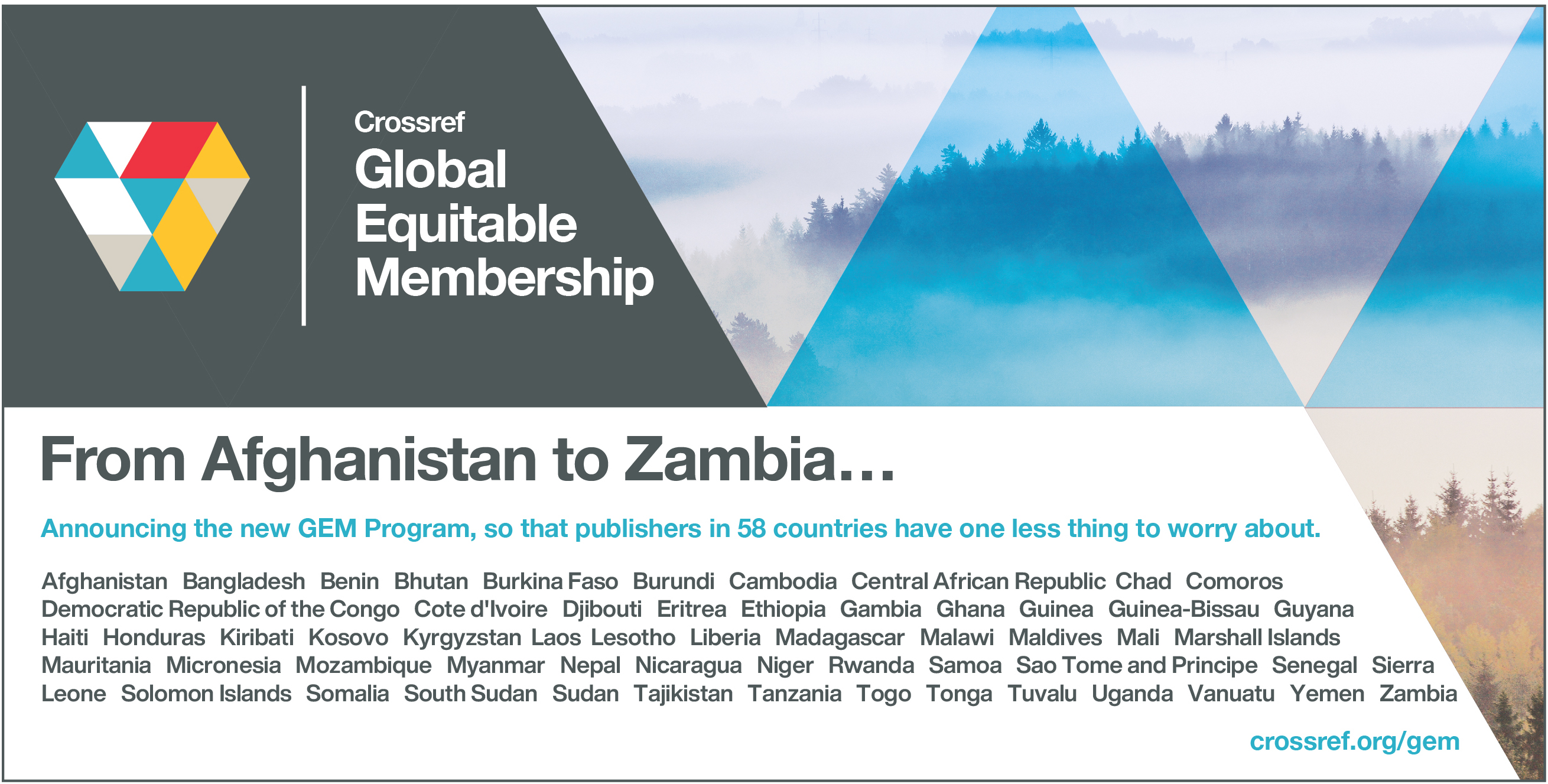
Additionally, we had a limited ‘fee assistance’ program to waive the content registration fees for members working under specific Sponsor arrangements, including INASP, and African Journals Online (AJOL). Learning from the experiences of such successful partnerships, starting in January 2023, we are expanding this program to provide greater membership equitability and accessibility to organisations located in the least economically-advantaged countries in the world through our Global Equitable Membership (GEM) Program. This new scheme now encompasses the annual fee as well as the content registration fees.
Eligibility for the program is based on a member’s country. We have curated the list, predominantly based on the International Development Association (IDA) list and excluding anywhere we are bound by international sanctions. From January 2023, organisations based in countries listed in our GEM program will be eligible to join Crossref and contribute with their metadata to a robust scholarly record at no cost. This also applies to 187 existing members in eligible countries who will no longer be charged for Crossref membership or content registration.
Existing Crossref members in GEM-eligible countries
Bangladesh (54)
Burundi (1)
Kiribati (0)
Kyrgyz Republic (20)
Central African Republic (1)
Lesotho (0)
Nepal (19)
Democratic Republic of the Congo (1)
Liberia (0)
Ghana (15)
Guyana (1)
Marshall Islands (0)
Yemen (10)
Haiti (1)
Mauritania (0)
Sudan (7)
Honduras (1)
Micronesia (0)
Tanzania (7)
Laos (1)
Mozambique (0)
Afghanistan (6)
Madagascar (1)
Nicaragua (0)
Ethiopia (5)
Malawi (1)
Niger (0)
Zambia (5)
Maldives (1)
Samoa (0)
Bhutan (4)
Myanmar (1)
Sao Tome and Principe (0)
Rwanda (4)
Cambodia (1)
Sierra Leone (0)
Tajikistan (4)
Chad (1)
Solomon Islands (0)
Kosovo (3)
Comoros (1)
South Sudan (0)
Senegal (3)
Cote d’Ivoire (1)
Togo (0)
Uganda (3)
Djibouti (1)
Tonga (0)
Burkina Faso (2)
Eritrea (1)
Tuvalu (0)
Mali (2)
Gambia (1)
Vanuatu (0)
Somalia (2)
Guinea (1)
Benin (1)
Guinea-Bissau (1)
The list of countries will undergo an annual review, to follow the latest guidance from IDA, which uses the somewhat simplistic World Bank income classifications but applies a more granular blend of criteria for economic health, thereby allowing for greater nuance, such as indicating countries where the gap between rich and poor is very wide.
The program results from our experience working with and knowing the communities through Sponsors and working with past members who have struggled to pay. It aims to bring us closer to our vision of building an inclusive, rich and open network of relationships underpinning the scholarly record. With the support of the Membership and Fees Committee, the launch of the program was confirmed with the recent unanimous vote of our Board to evolve our fee assistance program into a more expansive scheme. GEM presents a more comprehensive and equitable solution than our former arrangements. It involves an opportunity to join Crossref and contribute scholarly metadata to our global community on a zero-fee basis for membership and content registration. This offering will be applied by default to organisations based in all eligible countries, irrespective of joining through any specific Sponsor, or independently.
While the GEM Program will alleviate financial barriers, and we hope to see the numbers above grow significantly, the GEM program will not necessarily help ease technical or administrative burdens. We still need our valued Sponsors for that and we seek new Sponsors in the above locations. We would love to hear from organisations based in GEM countries who might consider becoming a Sponsor or otherwise support local colleagues in building experience of metadata and working with global open scholarly infrastructure systems like Crossref. Please reach out to me to discuss ideas or with any other questions or comments.