We’ve had a year full of growth and reached a milestone of 60+ team members; let’s take a moment to digest what that means for people operations. Hiring staff in 19+ countries is no easy task, but we are up for it, and I can honestly say it is the main reason why our culture is so great. That might sound biased coming from Crossref’s first Head of Human Resources, but hear me out.
You can now register rich metadata for a variety of record types in Metadata Manager using simple, guided workflows. The tool is used by many in our community to register grant and journal article records, and it has now been expanded to support books and chapters, reports, dissertations, and post-publication updates for journal content.
Metadata Manager makes it easier to capture identifiers for contributors and their affiliations, funding information, references, and more. Thanks to automated reference matching by Crossref, this offers greater visibility for the works, while the affiliations and funding information can serve as important trust signals for the community.
This year’s edition of the FORCE11 conference was hosted in June by Singapore Management University. Its title, “To Go Far, Go Together: Advancing Scholarly Communication Across Boundaries and Disruptions” truly resonates with Crossref’s truths; it takes a village! Crossref only works as long as the scholarly research community wants to work together globally, across all disciplines, for integrity and openness of the scientific record. The conversations were influenced by a genuinely diverse mix of librarians, researchers, open infrastructures, and service providers, and that mix shaped almost every interaction we had at the conference.
We have some rather unusual news to share: Crossref fees are going down again. At its meeting in Paris earlier this month, the Crossref Board approved two further recommendations from the Resourcing Crossref for Future Sustainability (RCFS) project: effective 1st January 2027, we will reduce the majority of Content Registration fees for all 25,000 members, and remove fees for back-year records altogether.
Content Registration fees haven’t increased in around 20 years, and this is the first significant change to them in that time—downwards. Since these fees account for the largest share of Crossref’s revenue (around 60%), and since every member registers DOI records, these changes reach further than anything we’ve announced under the RCFS project so far.
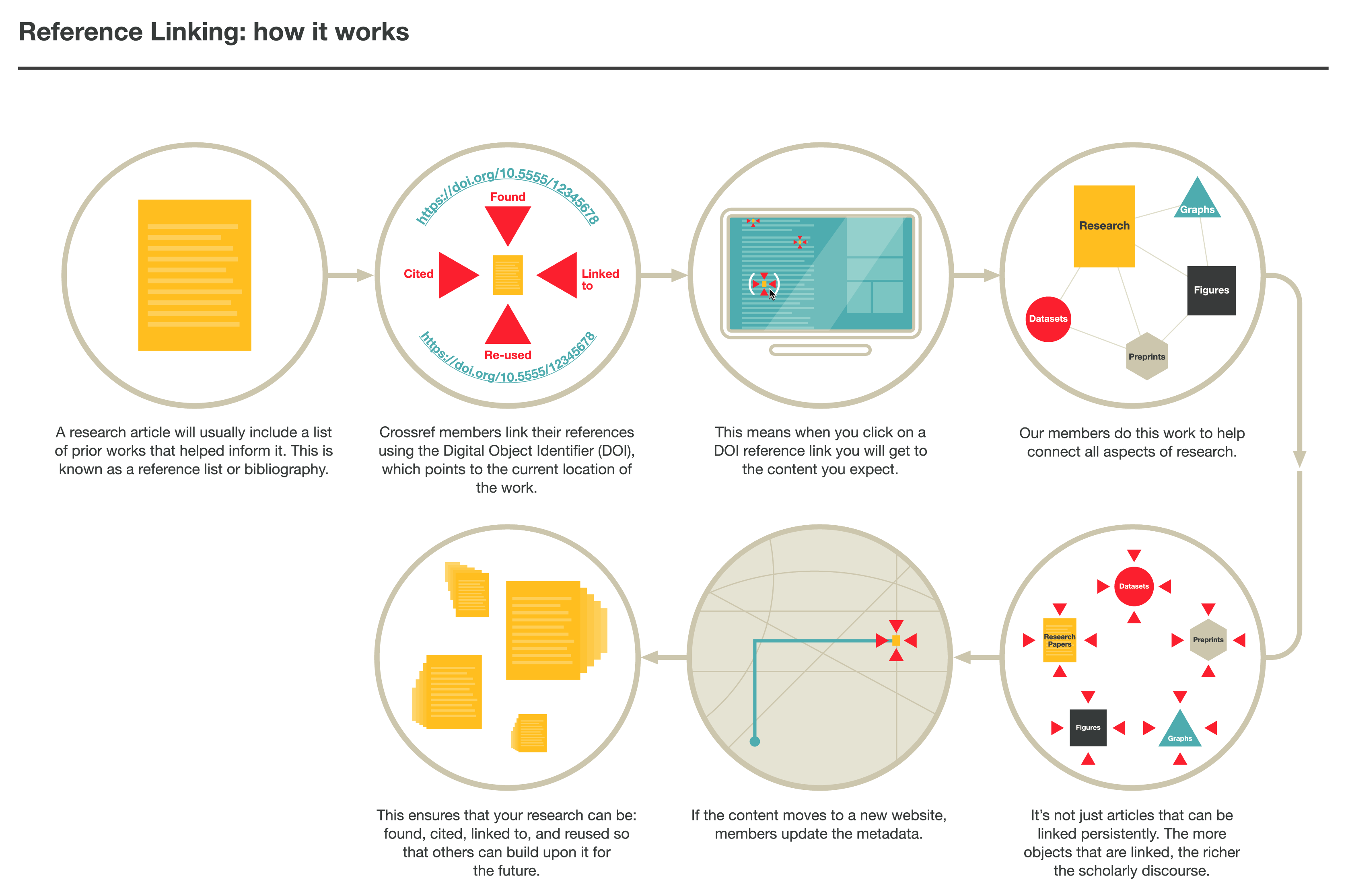
Reference linking enables researchers to follow a link from the reference list to other full-text documents, helping them to make connections and discover new things.
Reference Linking means including Crossref DOIs (displayed as URLs) in the reference lists that you provide in your own published work. This enables researchers to follow a link from a reference list to the current landing page for that referenced work. And because it’s a DOI rather than just a link, it will remain persistent.
So, instead of just including the reference in your reference list…
Soleimani N, Mohabati Mobarez A, Farhangi B. Cloning, expression and purification flagellar sheath adhesion of Helicobacter pylori in Escherichia coli host as a vaccination target. Clin Exp Vaccine Res. 2016 Jan;5(1):19-25.
…you should also display the DOI link:
Soleimani N, Mohabati Mobarez A, Farhangi B. Cloning, expression and purification flagellar sheath adhesion of Helicobacter pylori in Escherichia coli host as a vaccination target. Clin Exp Vaccine Res. 2016 Jan;5(1):19-25. https://doi.org/10.7774/cevr.2016.5.1.19
Because Crossref is all about rallying the scholarly community to work together, reference linking is an obligation for all Crossref members. But you don’t have to be a Crossref member to link your references - we provide free tools that anyone can use to match their reference lists to existing DOIs so they can link their references.
Watch the introductory reference linking animation in your language:
Persistent links enhance scholarly communications. Reference linking offers important benefits:
Reciprocity: members’ records are linked together and more discoverable because all members link their references.
As a member organisation, we can obligate all our members to link their references, so that individual members can avoid the inconvenience of signing bilateral agreements to link to persistent resources on other platforms. The result is a scholarly communications infrastructure that enables the exchange of ideas and knowledge.
Discoverability: research travels further when everyone links their references. Because DOIs don’t break if implemented correctly, they will always lead readers to the resource they’re looking for, including yours. When the DOIs are displayed, anyone can copy and share them. This will also enable better tracking of where and when people are talking about and sharing scholarly objects, including in social media.
Obligations and fees for reference linking
Reference Linking is an obligation of membership for all Crossref members. But anyone can use our support tools for Reference Linking - you don’t have to be a member. And there’s no charge to use our support tools for Reference Linking.
Getting started with reference linking
There are various different ways to look up other member’s DOIs to add to your reference lists. Read more here.