The Crossref community in India is as diverse as the region that it represents, comprising 1605 members, 11 sponsoring organisations, and 5 ambassadors, who between them cover the length and breadth of this country. Between November 2025 and March 2026, we organised three webinars focused on supporting this community with best metadata and publishing practices. We collaborated with the Directory of Open Access Journals (DOAJ) and the Committee on Publication Ethics (COPE) to embed understanding of metadata’s role in the greater context of publishing integrity.
PID strategies are being written around the world right now, and the decisions being made will shape the scholarly record for decades. After 25 years running open scholarly infrastructure—now on behalf of 25,000 members in 167 countries—Crossref has an informed perspective on what those decisions should ideally rest on. Today we’re setting it out in our first position paper: Persistent identifiers in research infrastructure policy: the need for a holistic approach. You can read it online or download the PDF; it’s a 16-minute read.
Research is rarely limited to a single contributor performing a single role. Behind every research output are people contributing in various ways: software development, data analyses, methodology design, and much more. Often, the same person contributes in several of these ways. Until now, Crossref metadata could only capture part of that picture, but this is changing with Schema 5.5.
Through user experience research (UXR) initiatives that take into account our diverse membership and community, we can have a continuous, deeper understanding of the role of metadata in our members’ workflows, and ensure that our work continues to meet our community’s needs. Your support is the key to this process, and will positively impact the wider community - and if you’d like to start today, you can take part in our latest initiative: help us improve our Events page by sharing your thoughts on the page’s feedback form.
ROR IDs as affiliations of authors can now be tracked in Participation Reports! Check your own Participation Report to see how many of your publications have author or grantee affiliations as ROR IDs in our metadata. If you deposit metadata via XML, see our guide on affiliations and ROR for instructions on how to include affiliations and ROR IDs in your metadata.
We encourage our members to include ROR IDs in metadata in order to help make research organisation information clear and consistent as it is shared between systems. ROR IDs are essential to realise a rich and complete Research Nexus because they enable connections between research outputs and the organisations that support researchers.
“At Scholastica, we care about taking steps to enrich metadata – like adding ROR IDs, for example, on behalf of our customers, so they don’t have to worry about the technical aspects of metadata collection or creation and can instead focus on maximizing the discovery benefits.” – Cory Schires, Co-founder and Chief Technology Officer, Scholastica
“If we’re talking about misconduct, then you might need to be able to contact the institution that the author is from. On an individual manuscript, it doesn’t matter if there’s no identifier – an address will do. But if you find some signal that is on manuscripts at scale, and you’ve got thousands of them, well, you need an identifier. You can’t go through them and try and search for every single one of those institutions.” – Adam Day, CEO, Clear Skies Ltd.
ROR IDs are specifically designed to be implemented in any system that captures institutional affiliations and to enable a richer networked research infrastructure. ROR IDs are interoperable with other organisation identifiers, including GRID (which provided the seed data that ROR launched with), the Open Funder Registry, ISNI, and Wikidata. ROR data is available under a CC0 Public Domain waiver and can be accessed at no cost via our public API and a data dump.
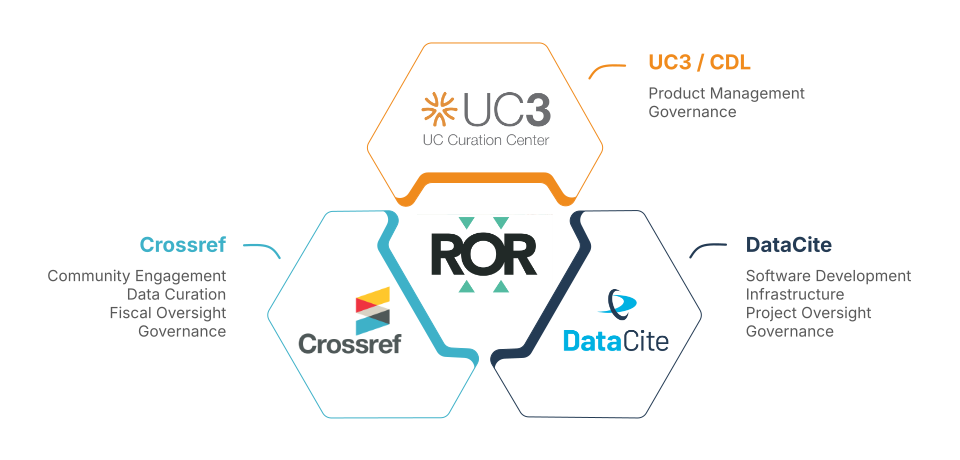
ROR is part of the open infrastructure we help run—not a separate organisation you need to deal with elsewhere. We co-founded it and operate it jointly with DataCite and the California Digital Library, and we launched it with seed data from GRID from Digital Science. Together we’ve invested in building an open registry of research organisation identifiers that can be embedded in scholarly infrastructure to link research to organisations effectively. ROR is not a membership organisation (or an independent legal entity at all!), and we charge no fees for use of the registry or the API. In fact, much of ROR’s day-to-day work is carried out by Crossref staff: as well as bringing 40% of its costs in-house following our board’s decision in 2022, we lead ROR’s community engagement and communications, its metadata curation and technical support, and its financial administration—holding ROR’s shared funds and running its bookkeeping and annual audit. The terms of this shared stewardship are set out in our Memorandum of Agreement (PDF).
Dedicated ROR staffing (2024): Crossref 2.1 FTE, DataCite 1.1 FTE, California Digital Library 0.75 FTE.
Why ROR IDs are an important element of our metadata
For a long time, we only collected affiliation metadata as free-text strings, which made for ambiguity and incomplete data. An author affiliated with the University of California at Berkeley might give the name of the university in any of several common ways:
University of California, Berkeley
University of California at Berkeley
University of California Berkeley
UC Berkeley
Berkeley
And likely more …
While it isn’t too difficult for a human to guess that “UC Berkeley,” “University of California, Berkeley,” and “University of California at Berkeley” are all referring to the same university, a machine interpreting this information wouldn’t necessarily make the same inference. If you are trying to easily find all of the publications associated with UC Berkeley, you would need to run and reconcile multiple searches at best, or, at worst, miss some data completely.
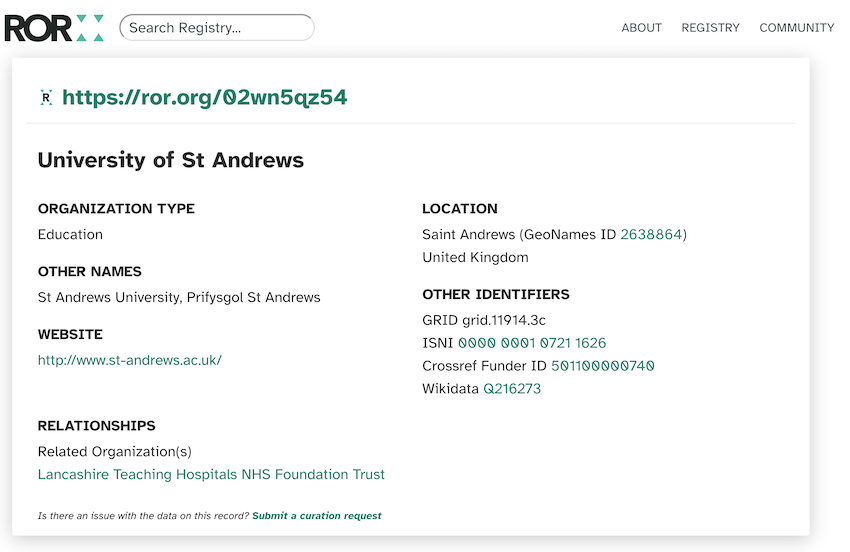
This is where an organisation identifier comes in: a single, unambiguous, standardised identifier that will always stay the same. For UC Berkeley, that would be https://ror.org/01an7q238.
In 2019, our members indicated that the ability to associate research outputs with organisations in a clean and consistent fashion was one of their most desired improvements to our metadata. In January of 2022, therefore, we added support for ROR IDs in our metadata schema and APIs. Since then, more and more members have been including ROR IDs in their metadata.
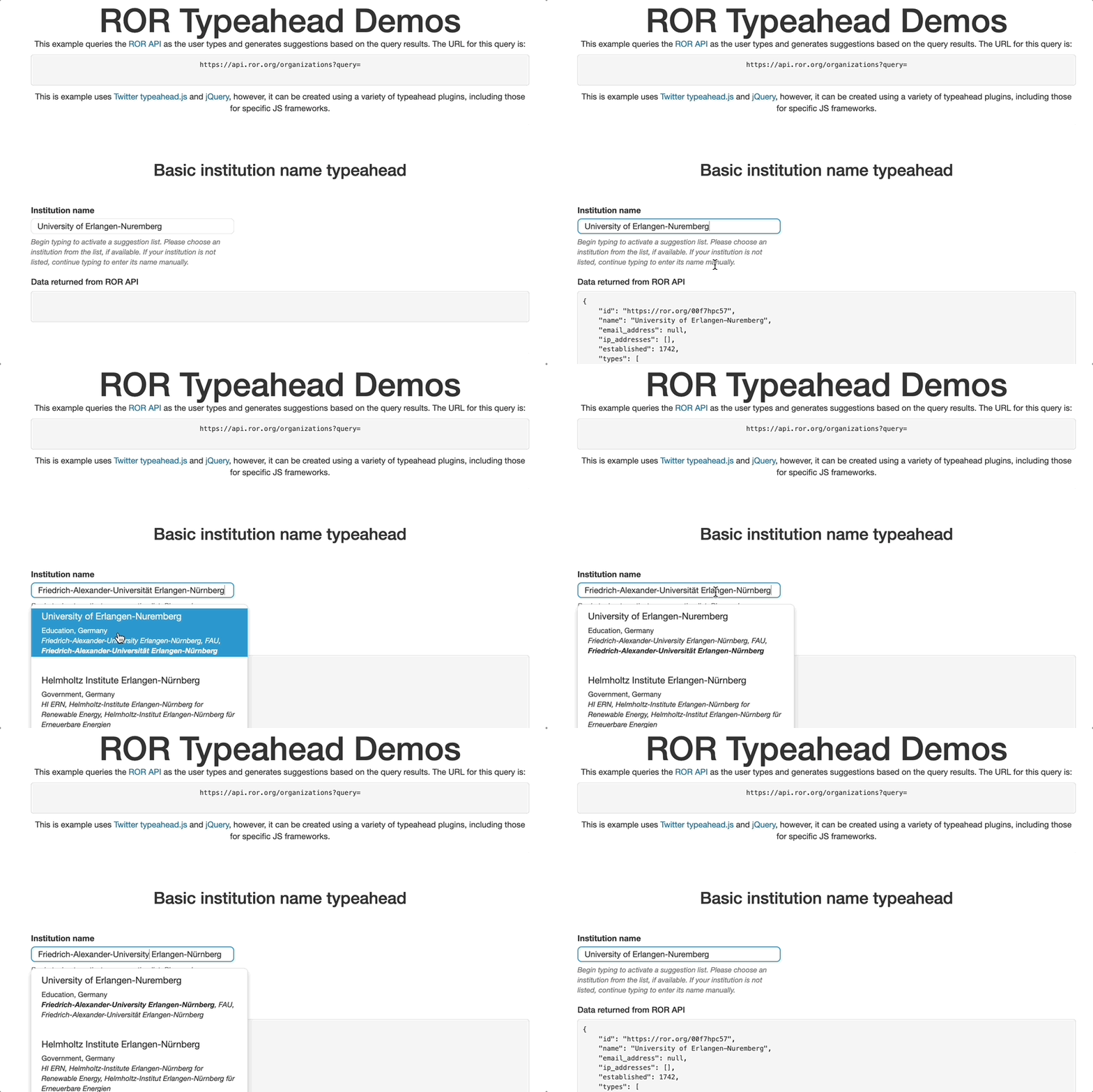
Publishers and service providers can implement ROR in their systems so that submitting authors and co-authors can easily choose their affiliation from a ROR-powered list instead of typing in free text. Authors themselves do not have to provide a ROR ID or even know that a ROR ID is being collected. This affiliation information can then be sent to us alongside other publication information.
Demo of collecting ROR IDs in a typeahead field
If the submission system you use does not yet support ROR, or if you don’t use a submission system, you’ll still be able to provide ROR IDs in your metadata. ROR IDs can be added to JATS XML, and our helper tools will start to support the deposit of ROR IDs. There’s also an OpenRefine reconciler that can map your internal identifiers to ROR identifiers.
ROR IDs for affiliations stand to transform the usability of our metadata. While it’s crucial to have IDs for affiliations, it’s equally important that the affiliation data can be easily used. The ROR dataset is CC0, so ROR IDs and associated affiliation data can be freely and openly used and reused without any restrictions.
The ROR IDs registered by members in their metadata are available via our open APIs so that they can be detected, analysed, and reused by anyone interested in linking research outputs to research organisations. Examples include:
Institutions who want to monitor and measure their research output by the articles their researchers have published
Funders who want to be able to discover and track the research and researchers they have supported
Academic librarians who want to find all of the publications associated with their campus
Journals who want to know where authors are affiliated so they can determine eligibility for institutionally sponsored publishing agreements
The inclusion of ROR IDs in our metadata will eventually help all these entities make all these connections much more easily.
Get ready to ROR 🦁!
ROR is already working with publishers, funders and service providers who are integrating ROR in their systems, mapping their affiliation data to ROR IDs, and/or including ROR IDs in publication metadata. Libraries and institutional repositories are also beginning to build ROR into their systems and to send ROR IDs to us in their metadata. See the growing list of active and in-progress ROR integrations for more stakeholders who are supporting ROR.
If you deposit metadata with us via XML, see our guide on Affiliations and ROR for instructions on how to include author affiliations and ROR IDs.
For further information on how ROR IDs are supported in our metadata, you can take a look at this .xsd file (under the ‘institution’ element) or in this journal article example XML. ROR also has some great help documentation for publishers and anyone else working with the ROR Registry.
Get in touch with us if you have questions about ROR, want to add ROR IDs to your metadata, or otherwise get more involved. You can also ask any questions on our community forum.