We’re providing a summary of the board’s March 2026 meeting. At the meeting, the board reviewed progress in our key programs and initiatives, the strategic outlook for 2026, filled a vacancy on the Board, considered an additional legal entity for Crossref, and reviewed our governance structures. The resolutions are available on the dedicated section of our website, which also lists the members of the Board and offers further information about our governance.
In April 2025, we launched the metadata matching project, in order to add missing relationships to the scholarly metadata. We will do this by consolidating all existing and planned matching workflows, which enrich member-deposited metadata in Crossref. This unified service will result in a more complete research nexus. In this blog post, we share our latest milestone: developing and evaluating a strategy for matching funder metadata to Research Organization Registry (ROR) identifiers.
Preserving the integrity of the scholarly record is an important component of the overall endeavour to protect research integrity. Open scholarly infrastructure enables persistent recording of research objects and associated metadata, which provides an evidence trail for these objects for all in the research community. Crossref and DataCite – as providers of essential infrastructure for preservation of the scholarly record – we share our joint expertise in the new guide on “Why metadata matters for research integrity and how to contribute”.
As our global community continues to grow, it is important for us to build and maintain our connections within it. In March this year, we had the opportunity to visit São Paulo for a community event at the Fundação Getúlio Vargas. The content of our presentations is available online. Events such as this provide an opportunity for us to update our members on Crossref fundamentals and developments, and help us better tune in to the varied needs of our communities and learn how we can work together more effectively. This was our third visit to Brazil, with previous events held in Campinas and São Paulo in 2016, and Goiânia and Fortaleza in 2018.
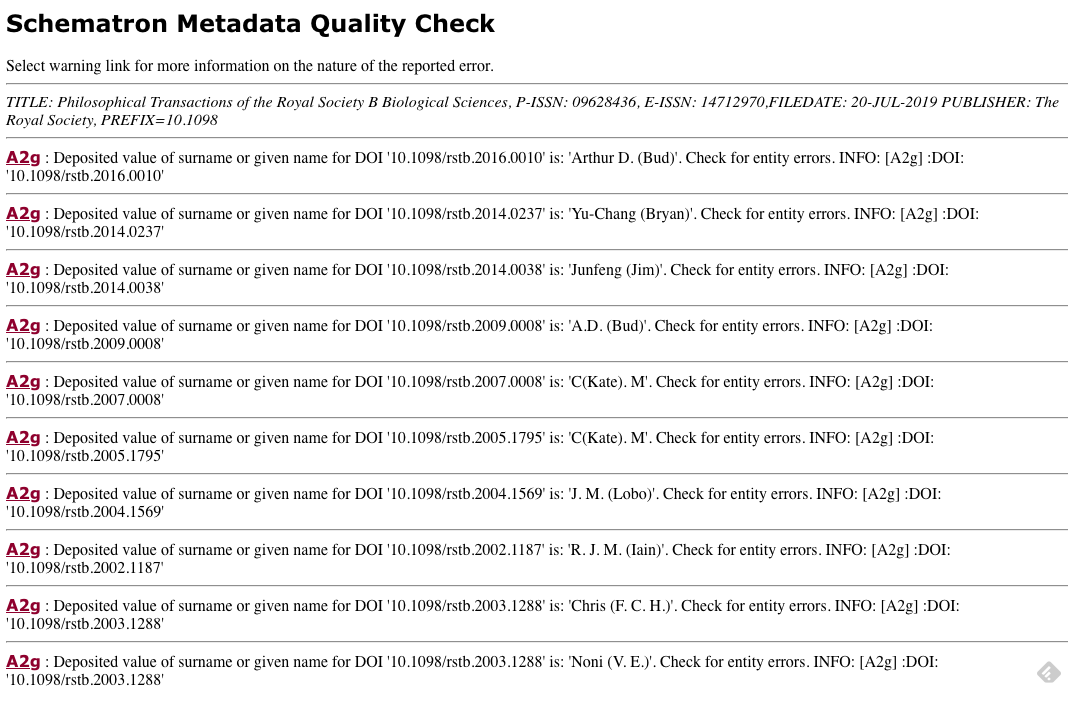
A Schematron report tells you if there’s a metadata quality issue with your records.
Schematron is a pattern-based XML validation language. We try to stop the deposit of metadata with obvious issues, but we can’t catch everything because publication practices are so varied. For example, most family names in our database that end with jr are the result of a publisher including a suffix (Jr) in a family name, but there are of course surnames ending with ‘jr’.
We do a weekly post-registration metadata quality check on all journal, book, and conference proceedings submissions, and record the results in the schematron report. If we spot a problem we’ll alert your technical contact via email. Any identified errors may affect overall metadata quality and negatively affect queries for your content. Errors are aggregated and sent out weekly via email in the schematron report.
What should I do with my schematron report?
The report contains links (organized by title) to .xml files containing error details. The XML files can be downloaded and processed programmatically, or viewed in a web browser: